The story behind the second key
A 2019 Honda Civic Sport hatchback parked near the Devonshire Mall corridor in South Windsor needed a spare smart proximity key. One working key in the family, no incidents, no panic. The owner had read enough about Honda's HISS immobilizer to know that the longer the car sat with only one fob, the more expensive an eventual all-keys-lost recovery would become. The owner chose to handle it before that day arrived.
A single mobile visit to the parking spot, on-site programming, and the Civic left with two fully working keys: the original plus an OEM-equivalent three-button smart proximity fob cut to the door blade code, paired through the Smart Key ECU and Multiplex Integrated Control Unit, and registered against Honda's online immobilizer table by a NASTF-authorized Vehicle Security Professional (VSP). The whole appointment landed inside 45 minutes.
From the Google Business Profile update
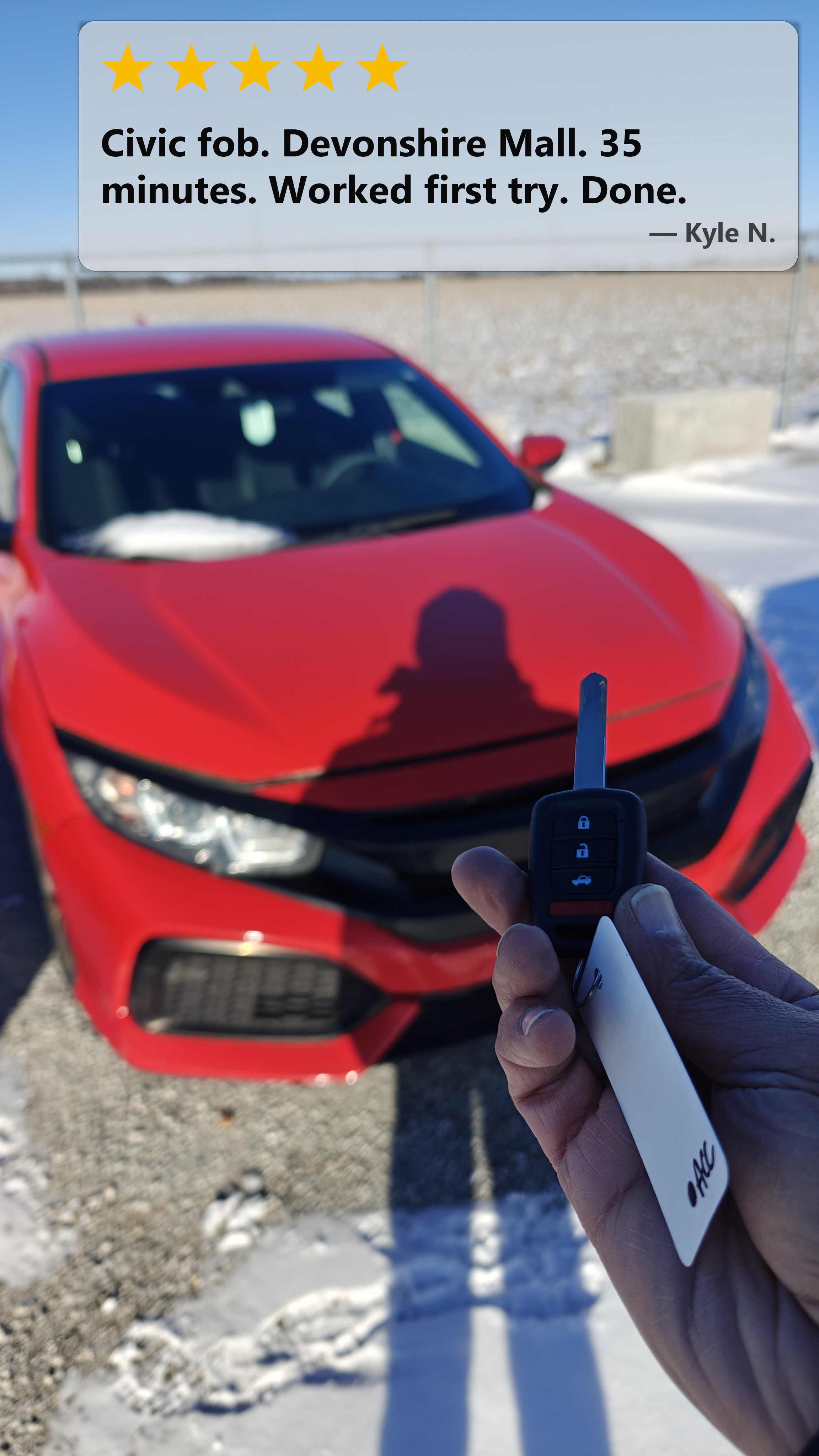
The image below is the actual photo Canadian Locksmiths posted to its Google Business Profile after the appointment. The short customer note on the embedded card reads:
★★★★★
"Civic fob. Devonshire Mall. 35 minutes. Worked first try. Done."
Shared by Kyle N. on the Canadian Locksmiths Google Business Profile
Vehicle and module specifics
The Civic covered in this post is the 10th-generation North American Civic hatchback, built on the FK7 and FK8 chassis codes (Sport, Sport Touring, EX, EX-L, and the high-output Si variant share these platforms). The 10th-gen Civic sedan and coupe (FC chassis) use the same smart-key architecture, so the workflow described here applies across all 10th-gen Civic body styles built for the Canadian market.
| Detail | Specification |
|---|---|
| Platform | 10th generation Civic, FK7 / FK8 hatchback chassis (FC sedan/coupe shares architecture) |
| Model years covered on-site | 2017, 2018, 2019, 2020, 2021 (hatchback); sedan and coupe 2016 through 2021 share the workflow |
| Trim coverage | LX, Sport, EX, EX-L, Sport Touring (hatchback); plus Si and Type R variants on FK8 |
| Fob style | Three-button smart proximity with passive entry and push-button start on Sport and above |
| Button layout | Lock, unlock, trunk release |
| FCC ID | KR5V2X (typical 2017-2021 builds), MLBHLIK6-1T (alternate late-cycle builds) |
| Honda part numbers | 72147-TBA-A11, 72147-TBA-A01 |
| Immobilizer system | HISS (Honda Ignition Security System), coordinated across Smart Key ECU, MICU, and Engine ECM |
| Fob battery | CR2032 |
| Blade code source | Door lock decode or Honda key code lookup against VIN through the iN portal |
The 72147-TBA part-number family is the 10th-generation Civic key code, distinct from the previous 9th-gen 35118-TR0 family and the 11th-gen 72147-T20 family. The A11 and A01 suffix split tracks fob hardware revision (battery contact and antenna layout); Canadian Locksmiths stocks both to fit any Canadian-spec 10th-gen Civic, including LX and Sport hatchback builds that left the factory with a transponder-only blade key rather than a proximity fob and were upgraded by the owner later on.
Tools used on this job
| Stage | Tool |
|---|---|
| Door lock decode (when no key code on file) | Lishi single-lift decoder for the HON66 keyway |
| Blade cutting | Triton PLUS Automotive Edition (Lock Labs) cutting a HON66 blank |
| Diagnostic and immobilizer pairing | Autel IM608 Pro over OBD-II with Honda HISS coverage pack |
| Online software activation (when required) | Honda HDS / I-HDS with active NASTF VSP-tied iN portal credentials |
| Verification | OBD-II scan tool for fault clear and a passive-entry walk-around at all four doors |
The Autel IM608 Pro carries native Honda HISS coverage for 10th-generation Civic spare-key registration with a working key present. The job runs over OBD-II without requiring the Honda iN portal as long as one key is already paired and the customer can hand it over for the registration session. For all-keys-lost recovery on the same platform, the workflow changes: the Smart Key ECU's existing seed must be cleared and re-paired against an immobilizer PIN pulled from Honda's online portal, which is gated by NASTF-authorized Vehicle Security Professional (VSP) credentials in North America. That distinction matters and is covered in the insider notes further down the post.
Honda's own diagnostic stack has split across two generations: the older HDS (Honda Diagnostic System) ran offline on a Windows laptop with a J2534 pass-through cable, and is still adequate for 10th-gen Civic key adaptation events. The newer I-HDS (Honda Internet Diagnostic System) replaced HDS for all 2014 and later models with online-required key registration on certain trims, and is the gold-standard path for any owner who walks the dealer route. Canadian Locksmiths runs the equivalent workflow through the Autel IM608 Pro paired with active NASTF VSP credentials, so the spare key leaves the appointment with zero diagnostic trouble codes in the Smart Key ECU, MICU, or Engine ECM logs.
What gets done on the appointment
The high-level sequence the technician follows for a Civic spare smart key:
- Confirm vehicle details. Read the VIN at the dash and door jamb, note the model year and trim, and confirm one working key is present. Quote the spare rate against the verified fob part number.
- Cut the mechanical backup blade. If the door lock code is on file with Honda, the blade is cut to code on the Triton PLUS. If not, the technician decodes the driver door cylinder with the Lishi HON66 decoder first.
- Pair the fob through the Smart Key ECU. With one working key present and the Autel session active, the new fob is added to the Smart Key ECU's key memory through the HISS adaptation channel coordinated with the MICU.
- Cross-validate against the Engine ECM immobilizer table. Once the Smart Key ECU writes the new key signature, the Engine ECM verifies the rolling code handshake. This step is what separates a fob that opens doors from a fob that actually starts the engine.
- Verify push-button start, passive entry, and trunk release. The technician walks all four doors, confirms passive unlock and lock at each, presses each button on the new fob, and runs an engine start.
- Hand off. The original key remains fully functional. The new fob is given to the owner along with the cut blade tucked into the fob's mechanical backup slot.
Troubleshooting common Honda Civic key issues
These are the calls Canadian Locksmiths handles every week from Civic owners who tried a budget option first.
- The new fob locks and unlocks but the engine will not crank. The fob was paired at the Smart Key ECU but the Engine ECM never received the rolling code cross-validation, or the validation timed out mid-session. Recovery is to re-open the HISS adaptation session against the Smart Key ECU's current state and trigger the ECM cross-validation again. Without that step the immobilizer logic permanently rejects the start request.
- The Civic accepts the new fob, but the original key now refuses to start the engine. Some aftermarket programmers wipe the existing key memory instead of appending to it. If both keys are still physically available, the original can be re-added through the same HISS adaptation channel as a fresh registration with the new fob serving as the trust anchor.
- Passive entry works for the driver door only. The B-pillar antenna in the offending door is either disconnected at the harness or the door antenna code was not properly assigned in Smart Key ECU configuration. Reading the long coding under the Smart Key ECU's service mode exposes the conflict.
- Push-button start works but the trunk release button does nothing. The radio frequency variant on the fob does not match the Civic's receiver. KR5V2X and MLBHLIK6-1T are not cross-compatible across all 10th-generation builds. Canadian Locksmiths verifies the variant against the VIN before cutting the blade.
Insider notes most owners never hear
The 10th-generation Civic's HISS implementation is reasonably well-documented at the dealer level, but the consumer-facing locksmith world rarely surfaces the deeper realities of the platform. The notes below are the technical reality from inside the work, not the marketing version. Senior Honda field technicians will recognize all of these; budget shops generally do not.
1. HISS uses session-based rolling codes, not a static seed
Older Honda immobilizer generations (8th-gen Civic and earlier) used a four-byte transponder code a technician could extract through OBD-II and store offline. The 10th-gen Civic abandoned that model. Every adaptation event runs a session-only challenge-response signed between the Smart Key ECU, MICU, and Engine ECM, with the rolling seed re-derived each ignition cycle. No static immobilizer code to retrieve, no master PIN to leak, no offline copy of the keying secret outside Honda's own iN portal. Forum posts claiming a static Honda code works on a 2017-plus Civic are misremembering older platforms or confusing the salvage-fob ID with the rolling seed.
2. Smart Key ECU, MICU, and Engine ECM are three coordinated gates
The Smart Key ECU stores fob IDs and the rolling-seed table. The MICU (Multiplex Integrated Control Unit) holds body and comfort data including door-antenna configuration. The Engine ECM holds the rolling-code immobilizer table that gates fuel-injector and starter relays. All three must agree on the active key before the engine will crank. Common rework call: a previous shop wrote the new fob into Smart Key ECU memory but the Engine ECM cross-validation never ran or failed silently, so the new key handles passive entry but the immobilizer refuses to release the engine. Recovery is to re-trigger the HISS adaptation against the Engine ECM through the Smart Key ECU's service routine.
3. Honda HDS, I-HDS, and the iN portal subscription stack
Honda's diagnostic platform has two generations live in the field. HDS is the older Windows-based app that runs offline on a J2534 pass-through cable; it covers 10th-gen Civic key adaptation events with one working key present. I-HDS is the newer Internet-required platform that gates certain procedures behind a live session against the Honda iN portal, including all-keys-lost recovery on the 2017-plus Civic. Annual cost of the full Honda iN subscription stack lands in the four-figure CAD range per workstation, on top of J2534 cable certification and NASTF VSP credential maintenance. That stack is the financial gap between a shop that can deliver a starting key on a HISS-immobilized Civic and one that cannot.
4. Pending-state half-paired keys on HISS
A new fob can be partially paired on the 10th-gen Civic. The fob ID is written into Smart Key ECU memory, but the Engine ECM cross-validation handshake never completes or times out. The Smart Key ECU stores a "pending" flag against that key slot. Symptoms: doors lock and unlock from the fob, the dashboard recognizes the key on approach, but the engine never cranks. Fix: re-open the HISS adaptation session so the Engine ECM sees the pending flag and completes the handshake on the second pass. Shops without working HISS coverage cannot finish this and hand the customer back a fob in pending state.
5. The voltage trap during HISS programming
The 10th-gen Civic's HISS adaptation writes to Smart Key ECU EEPROM and the Engine ECM immobilizer table in the same session, and both writes require a stable rail voltage. The Civic's body harness sheds non-essential loads at around 12.2V at the OBD pin (climate fan, infotainment), which can mask a deeper drop on the Smart Key ECU's internal regulator. The technician sees a healthy 12.3V on the scan tool and the write still fails because the regulator dropped below the 12.4V threshold during programming. Fix: a battery support unit clamped to the under-hood jump points, not the OBD pin, rated for at least 25A continuous. Plugged in for the full visit, not just session start.
6. First-key (all-keys-lost) recovery is a fundamentally different job
With one working key present, the Smart Key ECU trusts its existing rolling-seed table and the new fob is added into a free key slot through a standard HISS adaptation. With zero working keys, the technician must request a five-digit immobilizer PIN against the VIN from Honda's iN portal, gated by NASTF-authorized Vehicle Security Professional (VSP) registration in North America. Without VSP, a shop can sell a fob and cut a blade but cannot deliver a starting key on a 2017-plus Civic. Canadian Locksmiths holds active VSP credentials and is one of a handful of mobile shops in Essex County that does, which is why AKL Civic calls across Windsor, Tecumseh, LaSalle, Lakeshore, Amherstburg, Essex, Kingsville, and Leamington routinely route here.
7. HON66 blade tolerance and the Triton PLUS
The HON66 blade (catalogued as HU100R in some cross-reference tables) has 10 cut positions, each cut to one of four depth values stepped at roughly 0.5 mm. A Triton PLUS Automotive Edition cut to specification holds the blade within ±0.025 mm. Universal laser cutters without a dedicated HON66 jaw drift to ±0.15 mm or worse. The Civic's wafer lock binds at around ±0.05 mm cumulative error, with the rear hatch lock binding tighter than the door cylinder. A drifted blade rotates 45 degrees, hits the bind point, and locks up. The repair is not shimming or working it in; it is recutting on a proper jig.
8. Smart Key ECU door-antenna coding (Civic-specific)
The 10th-gen Civic's passive entry uses four B-pillar door antennas plus the rear hatch coil on the hatchback (trunk lid coil on sedan/coupe). Antenna coding lives under the Smart Key ECU's configuration menu, with a discrete coding byte per antenna assignment. The "passive entry works at the driver door but not the others" complaint traces almost always to either a B-pillar antenna failure (a known weakness on early-build 2017-2018 rear doors that saw water intrusion) or a coding byte that was not updated after a door swap from a base-trim Civic without passive entry hardware. Honda HDS reads the antenna coding and the conflict is obvious in under a minute.
9. Used-fob seed-key reset on the Smart Key ECU
A fob pulled from another 10th-gen Civic still carries the seed-key signature from its previous Smart Key ECU. Pairing it into a new Smart Key ECU throws HISS error code U1900 (Communication Bus Error) on the Engine ECM cross-validation step. Honda HDS has a Reset Key Seed function under Smart Key ECU > Service that wipes the previous binding so the fob re-pairs clean. Salvage-yard fobs are sometimes shipped pre-cleared; most are not. The clearing step is what separates a used fob that works from one the customer paid for and gets blamed on the locksmith.
10. Honda iN queue timing and the holiday window
For online activation events (all-keys-lost, PIN extraction, certain trim-specific procedures), Honda Canada's iN backend queues requests in arrival order across all dealer and VSP traffic globally. Friday afternoons before long weekends and the first business day after a stat holiday are the worst: a single ticket can stretch from the usual 60 seconds to 8-12 minutes per write. On an AKL recovery, that is the difference between a 90-minute and 150-minute appointment. Canadian Locksmiths schedules online-required Honda work, including Acura jobs that route through the same iN portal, early in the day mid-week whenever possible.
Cost and what to expect
A Honda Civic spare smart key, programmed and verified on-site in Windsor or anywhere across Essex County, starts at $349. Most jobs fall between $449 and $649+ once the specific fob part number, programming tool time, and door blade work are accounted for. A full quote is given before the technician dispatches; there are no surprise add-ons after the appointment.
For comparison, the typical Honda dealer route on the same car involves a tow to the dealership (often $150 to $250+), a service bay slot that may be days out, and a labour book rate that lands in the $700 to $1,100+ range before the fob itself is invoiced. Canadian Locksmiths runs the same HISS adaptation routine the dealer uses, on a mobile-van laptop, and finishes the appointment at the customer's parking spot rather than tying up the family's only vehicle for a day at the service department.
Book a Honda Civic spare smart key with Canadian Locksmiths or call (519) 979-1270 for a full quote against the VIN before dispatch.
Frequently asked questions
Q: Can a 10th-gen Civic spare key be programmed without bringing the car to a dealer? A: Yes. Canadian Locksmiths uses the Autel IM608 Pro with Honda HISS coverage and active NASTF-authorized Vehicle Security Professional (VSP) credentials, which is the equivalent stack to the dealer's Honda HDS / I-HDS workflow. The job is finished at the customer's location, with one mobile visit and no tow.
Q: How long does the appointment take? A: A spare smart key with one working key already present is generally a 35 to 60 minute appointment, depending on whether the door blade needs to be decoded on-site or is cut to a known door code. The Civic photographed for this post finished in about 35 minutes.
Q: Will the original key still work afterward? A: Yes. The HISS adaptation appends the new key to the Smart Key ECU's memory without removing the original. Both keys leave the appointment fully paired and cross-validated against the Engine ECM immobilizer table.
Q: What if all the keys are already lost? A: All-keys-lost recovery on a 2017-plus Civic is a separate, longer job that requires a five-digit immobilizer PIN pulled online against the VIN from Honda's iN portal. That portal access is gated by NASTF VSP credentials. Canadian Locksmiths handles those calls too, and the call is best made before the car gets towed anywhere: a flatbed trip and a dealer service slot are both expensive avoidable steps when a mobile VSP-credentialed locksmith can show up to the parking spot instead.
Q: Which Civic years are covered by this HISS workflow? A: 2017 through 2021 Civic hatchback (FK7, FK8) and 2016 through 2021 Civic sedan and coupe (FC), in all Canadian-spec trims including LX, Sport, EX, EX-L, Sport Touring, Si, and Type R. Pre-2016 Civics use an older HISS revision and follow a different procedure. The 2022-plus 11th-gen Civic uses a refreshed HISS coordinated through a different Smart Key ECU part family and is covered in a separate workflow.
Q: Does Canadian Locksmiths service Civics outside Windsor? A: Yes. Mobile dispatch covers Windsor, Tecumseh, LaSalle, Lakeshore, Amherstburg, Essex, Kingsville, Leamington, and the rest of Essex County, Ontario.